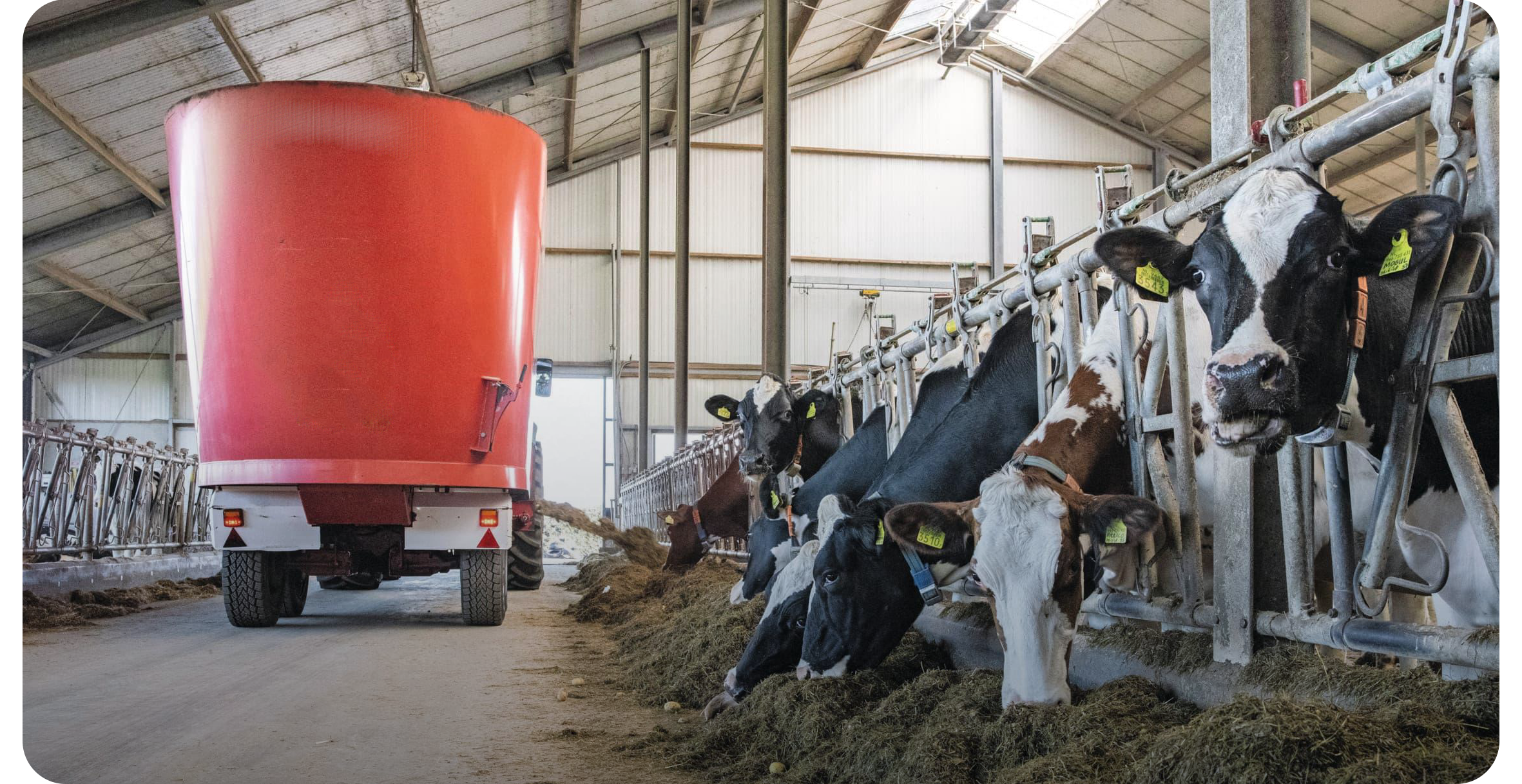
Feeding represents one of the largest costs on a dairy farm and, at the same time, one of the factors that most directly affects animal performance.
For this reason, managing feeding efficiently means much more than simply preparing the right ration.
Farmers need to know whether operators prepared the ration correctly, whether each group received the right amount of feed and how much the animals actually consumed. Moreover, they need to understand how ingredient quality changes over time and how feeding decisions affect production and profitability.
This is where feed management systems for dairy farms play an increasingly important role.
Modern feed management technologies connect ration planning, feed preparation, delivery and performance monitoring. As a result, farmers can transform everyday feeding activities into measurable data that supports better decisions.
A feed management system is a digital solution that helps farmers manage and monitor the entire feeding process.
Depending on the technology, farmers and nutritionists can use it to manage:
More advanced systems go beyond recording what happens during ration preparation.
Instead, they create a continuous flow of information from ration planning to feed delivery and performance analysis. Therefore, farmers and nutritionists gain a clearer view of what actually happens every day.
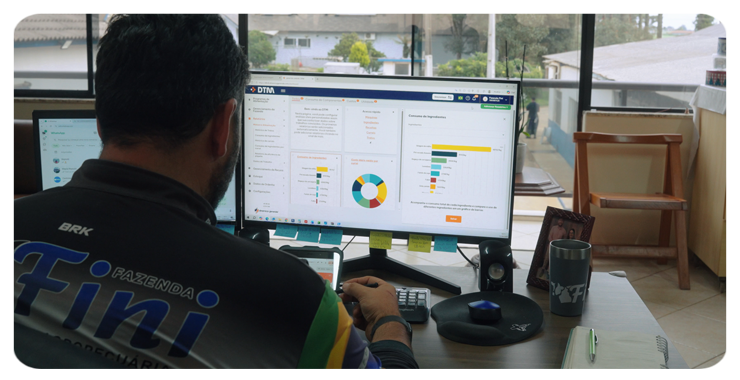

A nutritionist can formulate a perfectly balanced ration on paper. However, the final result also depends on how accurately the farm prepares and delivers that ration.
Small variations occur every day.
For example, operators may load slightly different quantities of ingredients. Ingredient dry matter can change. Forage quality can vary. In addition, animals may consume more or less feed than expected.
When farms do not measure these variations, they can gradually create a gap between the ration that the nutritionist planned and the ration that the animals actually receive.
A feed management system helps reduce this gap by providing objective information throughout the feeding process.
Therefore, instead of relying only on assumptions, farmers can compare planned feeding activities with actual execution.
Not every feed management solution offers the same level of control.
Therefore, when evaluating a system for a dairy farm, it is important to consider several key areas.
First of all, the system should make it easy to create, modify and manage feeding recipes.
Farmers and nutritionists should also be able to share changes quickly with the people responsible for preparing the ration. As a result, operators can always work with updated feeding instructions.
Moreover, farms that change diets frequently can benefit from tools that allow them to plan future adjustments.
For example, a farmer or nutritionist may want to introduce or remove an ingredient on a specific date. Alternatively, they may want to gradually increase or decrease its quantity according to a predefined feeding strategy.
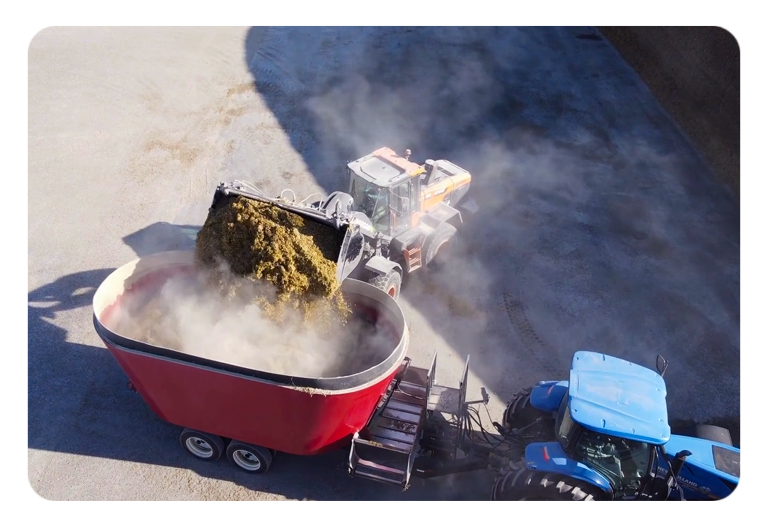
Knowing what operators should load is only the first step. The farm also needs to know what operators actually load into the mixer wagon.
By connecting feed management software with the weighing system, farmers can monitor loading accuracy and identify repeated overloading or underloading of specific ingredients.
Consequently, better loading accuracy can support more consistent rations and improve control over feed costs.
Once operators prepare the ration, another important question arises:
Did every group receive the amount of feed that was planned?
For this reason, a complete feed management system should monitor unloading and feed delivery as well as loading.
By tracking the quantities delivered to each pen or group, farmers can quickly identify differences between planned and actual feeding.
In addition, monitoring delivery times can provide valuable information about feeding routines and operational consistency.
Monitoring feed intake only on an as-fed basis does not always provide the complete picture.
In fact, the dry matter content of ingredients can change significantly, especially in silages and other moist feeds.
Therefore, monitoring dry matter intake helps farmers and nutritionists understand more accurately how much feed the animals actually consume on a dry matter basis.
Moreover, combining feeding data with information about ingredient dry matter makes it easier to compare intake consistently over time.

What animals leave behind is just as important as what the farm delivers.
Monitoring feed refusals helps farmers determine whether the quantity delivered to each group matches actual intake.
For example, consistently high refusals may indicate unnecessary feed costs. On the other hand, very low refusals may suggest that the farm should review feed availability.
Therefore, farmers should analyse refusal data together with delivered feed and dry matter intake rather than considering it as an isolated value.
Feed management also has an important economic dimension.
A digital system can help farmers monitor ingredient usage and update inventory according to actual feeding activities.
As a result, farmers gain better visibility over:
Moreover, when ingredient prices change, farmers can immediately understand how those variations affect overall feeding costs.
This information can support purchasing decisions, stock management and ration cost control.
Collecting data alone does not improve feeding performance.
Instead, farms need tools that transform everyday feeding activities into clear and useful KPIs.
For example, farmers and nutritionists can monitor:
Dashboards and reports make these indicators easier to interpret. Consequently, users can identify trends, exceptions and areas for improvement without manually analysing every feeding record.
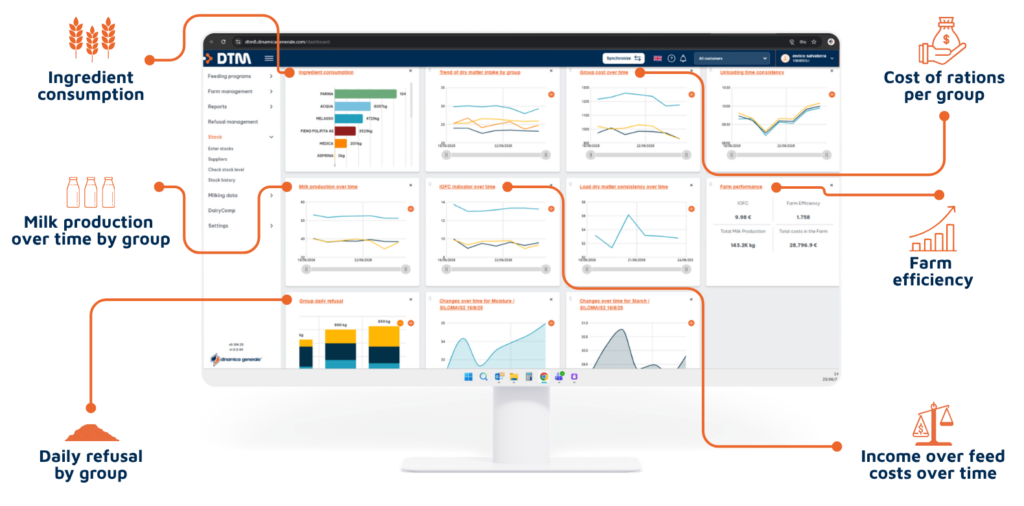
Feeding performance does not exist in isolation.
For example, feed intake becomes much more meaningful when farmers compare it with milk production.
For this reason, connecting feeding information with herd management data allows farms to calculate indicators such as feed efficiency and Income Over Feed Cost.
As a result, farmers can move from asking: “How much are we feeding?” to a much more relevant question: “What results are we obtaining from the feed we are using?”
Another challenge in dairy feeding comes from ingredient variability.
Forages do not always have the same nutritional characteristics. Their composition can change between fields, silos and loads. Moreover, quality can vary even within the same storage structure.
Therefore, farms can improve feed management by combining it with NIR analysis.
Near Infrared technology allows farmers to analyse important nutritional parameters of feed ingredients directly on the farm.
By combining NIR analysis with weighing and feed management data, farms can create a stronger connection between:
what the nutritionist formulated, what the operator loaded, what the farm delivered and the actual quality of the ingredients used.
Feed management is increasingly evolving towards a broader concept: precision feeding.
Precision feeding combines different technologies to manage the feeding process using real data.
For example, a connected ecosystem can bring together:
NIR analysis → Weighing → Ration preparation → Feed delivery → Intake monitoring → Performance analysis
Each step generates information that adds value to the next.
Therefore, the goal is not simply to collect more data. Instead, the goal is to make the feeding process more consistent, measurable and easier to manage.
Dinamica Generale developed DTM – Daily TMR Manager to connect the different stages of the dairy feeding process within a single digital environment.
DTM supports ration planning and execution while collecting data from compatible weighing systems installed on mixer wagons.
As a result, farmers and nutritionists can monitor feeding activities, ingredient stocks, costs and key performance indicators from one platform.
For example, they can analyse:
Moreover, customizable dashboards allow each user to focus on the information that matters most for their farm.
DTM can also combine feeding information with data from other farm management systems and Dinamica Generale NIR technologies. Consequently, farmers and nutritionists can gain a more complete view of the feeding process.
Improving feeding efficiency does not always require a complete change in ration formulation.
In many cases, the first opportunity comes from understanding more accurately how the farm executes its existing feeding strategy.
A feed management system gives farmers and nutritionists the tools to compare the plan with reality, identify deviations and evaluate their impact over time.
Ultimately, by connecting ration management, weighing, ingredient quality, feed delivery and performance data, dairy farms can move from simply managing feed to actively managing feeding performance.
Discover how DTM and Dinamica Generale precision feeding technologies can help you connect ration planning, feed preparation, delivery and performance analysis within one integrated ecosystem.


 NIR & Imaging
 Data Management
 Mobile Apps
 Load Cells
 Indicators and ISOBUS-ECU
 Accessories
 English
 Italian
 Spanish
 French
 German
 Portuguese (Brazil)
 Dutch
Dutch Polish
 Chinese (Simplified)
 Turkish
