In Field
 Harvesting
 Soil Preparation
Baling traditionally focuses on volume and moisture, but forage quality often remains unknown until feeding, when it is too late to optimize decisions.
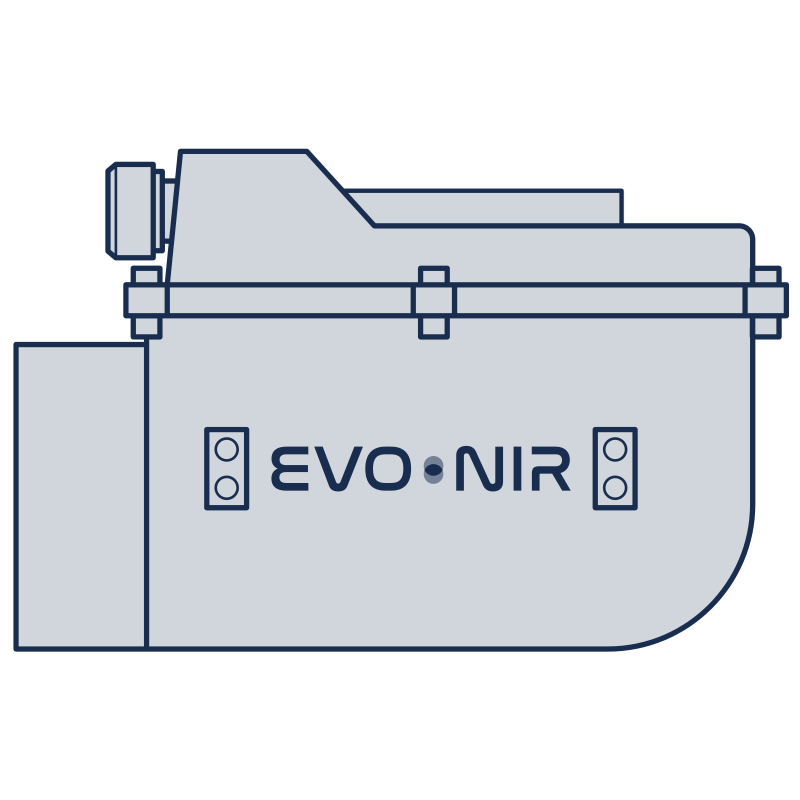
By installing EVONIR sensor on balers, forage composition can be measured continuously during bale formation, transforming the process into a real-time bale quality monitoring operation.


When forage is not analyzed on board during baling, variability in parameters such as moisture, protein and fiber becomes visible only after storage, when operational adjustments can no longer be made.
EVONIR allows operators to:
Dinamica Generale offers technologies that integrate forage analysis and weighing directly on balers. By combining EVONIR sensors, load cells and digital platforms, each bale can be monitored in real time in terms of both quality and weight.
This enables full traceability and supports better storage and feeding decisions from bale formation to feeding management.
Dinamica Generale offers a range of load cells for baler weighing systems, designed to measure the weight of each bale during formation and handling operations. Available in multiple models to fit different baler types and configurations, they ensure accurate and reliable performance even in dynamic field conditions. The integration of weighing systems with NIR sensors allows full characterization of each bale, combining quality and quantity data into a single, traceable dataset.
Key advantages for balers

EVONIR is an on-board NIR analyzer installed on balers, along the forage flow, to continuously scan the material during bale formation. The sensor measures key forage parameters such as moisture (dry matter), crude protein and fiber (ADF, NDF) directly in real time. Data are transmitted via ISOBUS or CAN J1939 and displayed on the tractor’s Virtual Terminal, allowing operators to monitor forage quality continuously during baling operations.
Key advantages for balers
Installing a NIR sensor on a baler does not just measure forage quality — it directly improves feed efficiency and forage utilization, two key cost drivers in dairy and livestock farming. Feed represents around 50–60% of total production costs (FAO, 2018; USDA ERS), while dry matter losses during baling and storage can range from 5% to over 15% depending on moisture conditions (Holmes & Muck, University of Wisconsin Extension).
By measuring each bale in real time, EVONIR helps operators bale at the correct moisture, classify forage by nutritional value and optimize feeding strategies, reducing losses and improving overall farm profitability.
Contact our experts to discover more about baler NIR analysis
FIELD trace automatically collects and organizes data into field-level insights, allowing farmers, contractors and agronomists to better understand forage variability and bale quality.
Key advantages for balers


Please fill out the form below and our team will be happy to answer any questions you may have.


 NIR & Imaging
 Data Management
 Mobile Apps
 Load Cells
 Indicators and ISOBUS-ECU
 Accessories
 English
 Italian
 Spanish
 French
 German
 Portuguese (Brazil)
 Dutch
Dutch Polish
 Chinese (Simplified)
 Turkish

 Forage Harvester
 Combine Harvester
 Forage Wagon
 Baler
Baler Grain Cart
 Seed Tender
 Vegetable Harvester
 Slurry Tanker
 Manure – Mineral Spreader