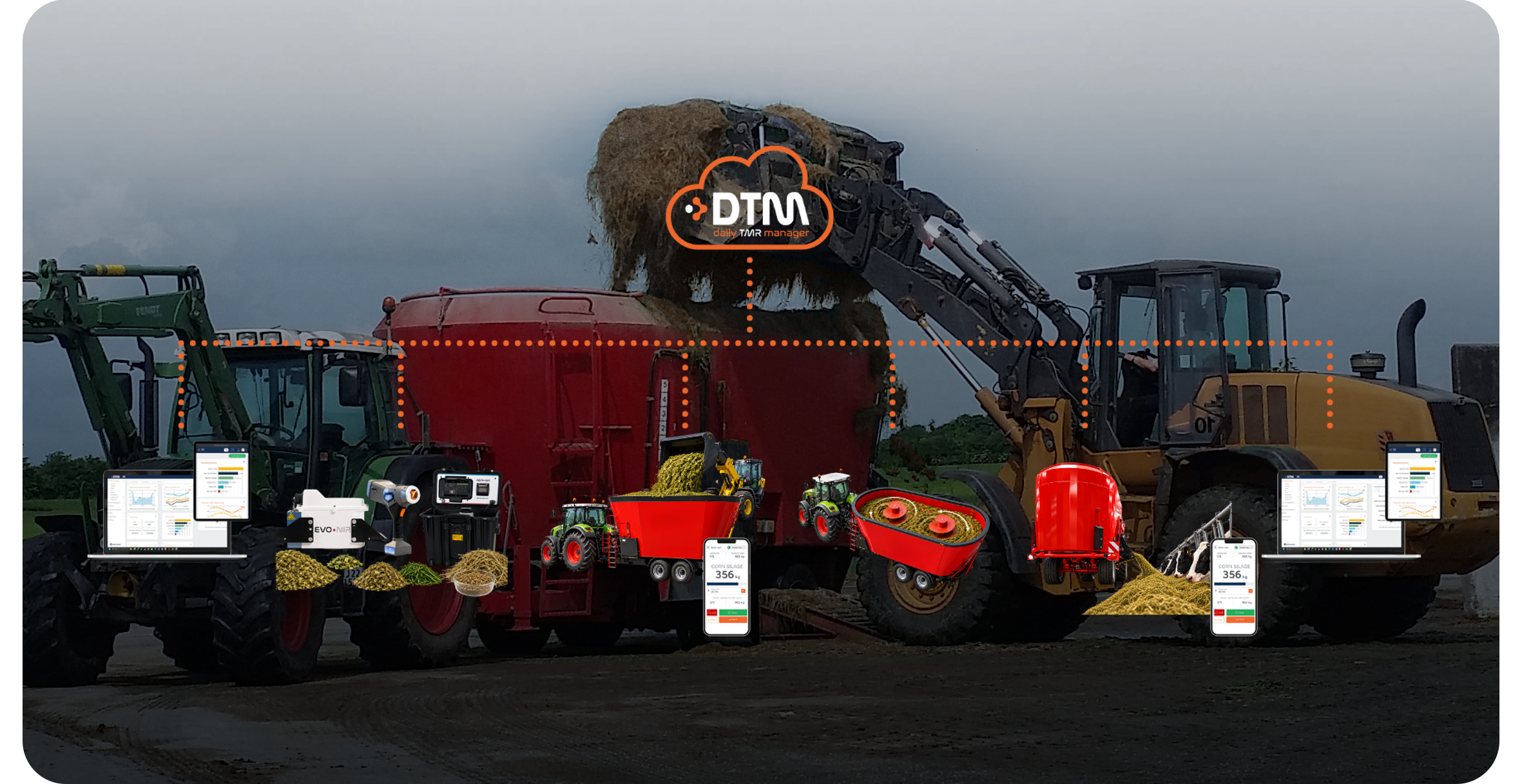
Precision Feeding goes far beyond preparing the right ration. It means making sure that farmers actually load, mix and deliver what they planned.
Every step can introduce variability. Ingredient composition changes over time. Operators may load quantities that differ from the target. Mixing conditions can also vary, while each group may receive a different amount of feed than planned.
Therefore, effective Precision Feeding requires a connected approach.
The Dinamica Generale Precision Feeding Ecosystem combines feeding software, NIR analysis, weighing technologies and machine control. Together, these technologies connect every stage of the feeding process.
Plan. Analyze. Load. Mix. Unload. Monitor and optimize.
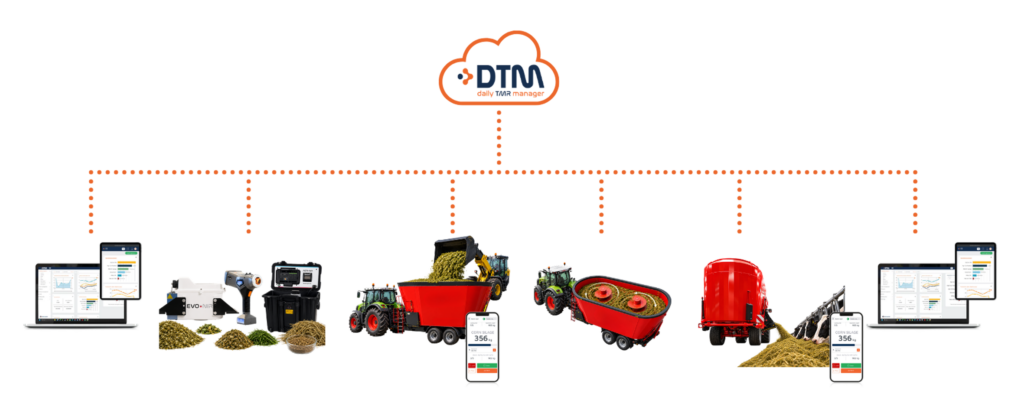
The objective is simple: turn everyday feeding operations into measurable processes and use real data to continuously improve feeding performance.
Every feeding process starts with a plan. With DTM – Daily TMR Manager, farmers and nutritionists can define rations, ingredients, animal groups and feeding quantities.
DTM turns this information into a clear reference for the entire feeding process.
As a result, operators know what to feed, how much to prepare and which group should receive each ration.
However, planning represents only the first step. To prepare the ration accurately, farmers also need to know the actual characteristics of their ingredients.
Feed ingredients naturally change over time. For example, silage may vary according to the harvesting area, storage conditions or moisture level. Differences between batches can also affect its nutritional composition. For this reason, theoretical values or occasional laboratory analyses do not always represent the feed that farmers actually use every day.
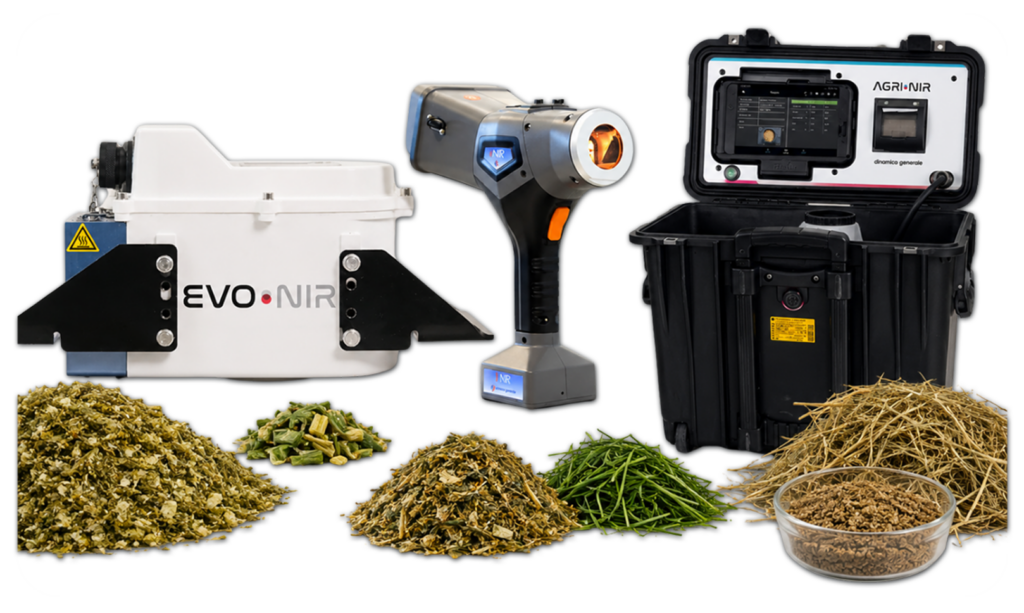
Dinamica Generale offers different NIR solutions, including EVONIR, AGRINIR and X-NIR, to analyse feed and forage directly where farmers need the information.
Depending on the application and calibration, these technologies measure parameters such as Dry Matter, protein, fibre and other nutritional values.
Consequently, farmers and nutritionists can work with the actual composition of the ingredients instead of relying only on estimated values.
Better ingredient information creates a stronger foundation for the next step: accurate loading.
Once the farmer has defined the ration and evaluated the ingredients, execution becomes critical.
Even a perfectly formulated ration can change if the operator loads too much or too little of one ingredient.
Dinamica Generale weighing systems show the weight in real time throughout the loading process. Operators can follow the planned ingredient sequence and continuously compare the actual quantity with the target.
Accurate weighing therefore reduces deviations between planned and actual quantities.
The concept is simple: the right ingredient, in the right amount.
Accurate loading also creates the right conditions for a consistent mixing process.
Correct quantities alone do not guarantee a good TMR. Farmers also need an effective and repeatable mixing process.
The objective goes beyond moving ingredients inside the mixer wagon. A good mixing process should create a homogeneous and consistent Total Mixed Ration.
Several factors can influence the result, including mixing time, ingredient sequence and daily operating procedures.
By controlling these factors, operators can make ration preparation more consistent from one batch to another.
Greater process repeatability also helps limit variations in the final TMR. In turn, a more homogeneous ration can reduce the opportunity for animals to select individual components.
The goal is clear: turn accurately loaded ingredients into a homogeneous and repeatable TMR.
The next challenge is making sure that each group receives it correctly.
Precision Feeding continues after mixing.
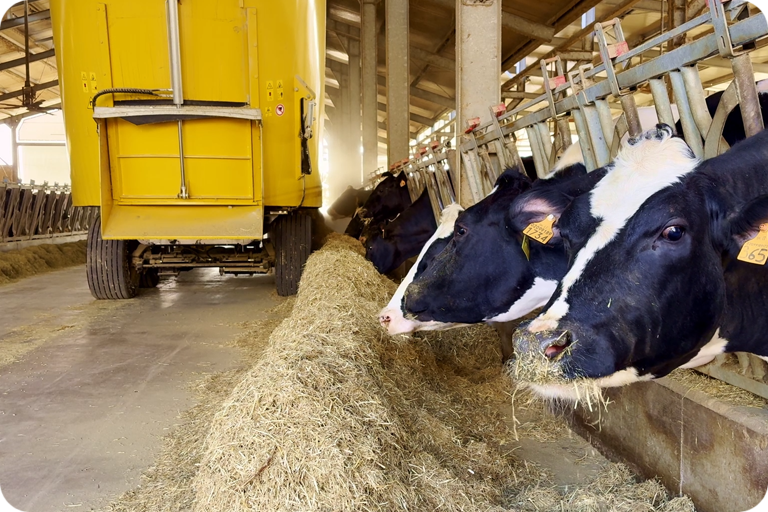
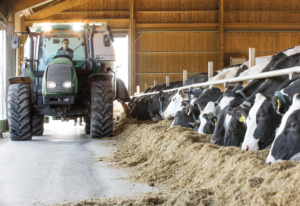
Operators still need to deliver the prepared TMR to the correct group, at the right time and in the planned quantity.
During distribution, Dinamica Generale weighing technologies and DTM help operators track how much feed they deliver to each group.
Farmers can then compare target quantities with actual delivery and identify possible deviations.
This adds another level of control to the feeding process: Right ration. Right group. Right amount.
However, delivery does not represent the end of the process. The data collected during daily feeding can provide valuable information about what happened and what farmers can improve.
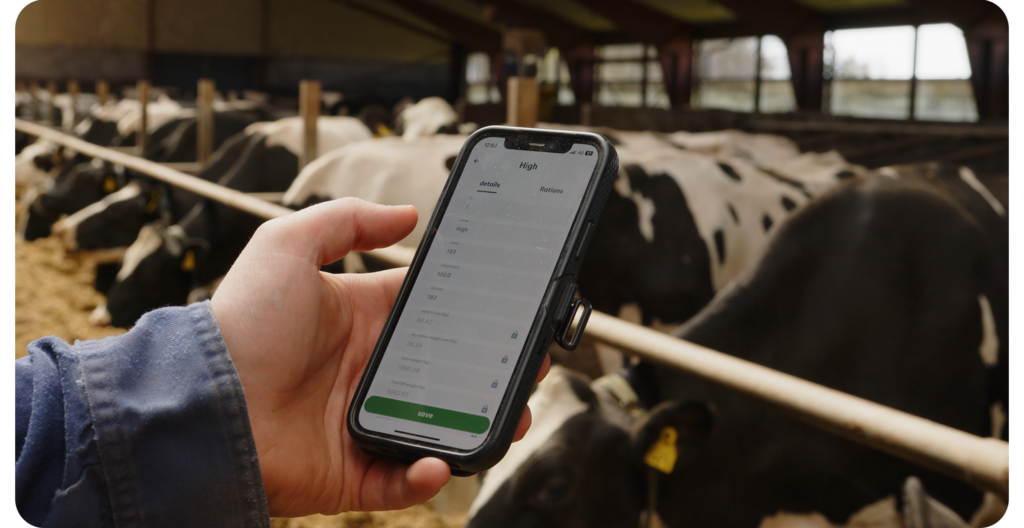
With the DTM App in Scale Control mode, operators can control weighing operations directly from their smartphone during both loading and unloading.
Connected via Bluetooth to compatible Dinamica Generale weighing indicators, the app displays the information needed to execute the feeding plan directly where the operation takes place.
During loading, operators can follow the ingredient sequence and compare target and actual quantities. During unloading, they can monitor the amount delivered to each group.
This creates a direct connection between the feeding plan and its execution on the mixer wagon.
Plan in DTM. Execute with the DTM App. Monitor the results in DTM.
Discover our DTM app
After preparing and delivering the ration, one question becomes essential:
Did the actual feeding process match the plan?
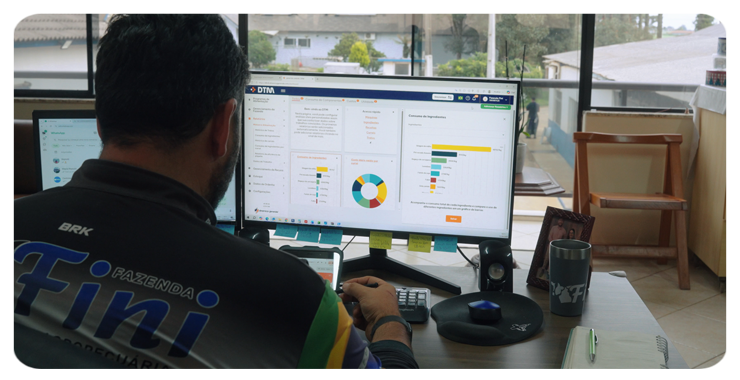
DTM collects and organises feeding data to help farmers, nutritionists and farm managers answer this question. Users can monitor indicators such as planned vs actual quantities, feed refusals, Dry Matter Intake, Feed Efficiency, IOFC, ingredient consumption and feeding costs.
These KPIs turn everyday feeding activities into measurable information.
For example, increasing feed refusals may highlight the need to review delivered quantities. Changes in ingredient prices can reveal their impact on ration costs. Moreover, differences between planned and actual quantities can help identify issues in feeding execution.
Therefore, data does more than record what happened.
It helps improve what happens next. The entire feeding process becomes a continuous cycle: Measure. Understand. Improve.
The real value of Precision Feeding comes from connecting every step.
Feeding software provides the plan, but accurate execution also requires weighing. NIR analysis adds information about the actual quality of the ingredients. Meanwhile, monitoring tools show what happened during loading and delivery.
When all these technologies work together, data flows across the entire feeding process.
PLAN → ANALYZE → LOAD → MIX → DELIVER → MONITOR & OPTIMIZE
This is the concept behind the Dinamica Generale Precision Feeding Ecosystem.
Dinamica Generale connects ration planning, ingredient analysis, weighing, feeding execution and performance monitoring within one process.
As a result, farmers gain greater control over daily feeding operations. They can also improve consistency and use reliable information to support both nutritional and economic decisions.


 NIR & Imaging
 Data Management
 Mobile Apps
 Load Cells
 Indicators and ISOBUS-ECU
 Accessories
 English
 Italian
 Spanish
 French
 German
 Portuguese (Brazil)
 Dutch
Dutch Polish
 Chinese (Simplified)
 Turkish
