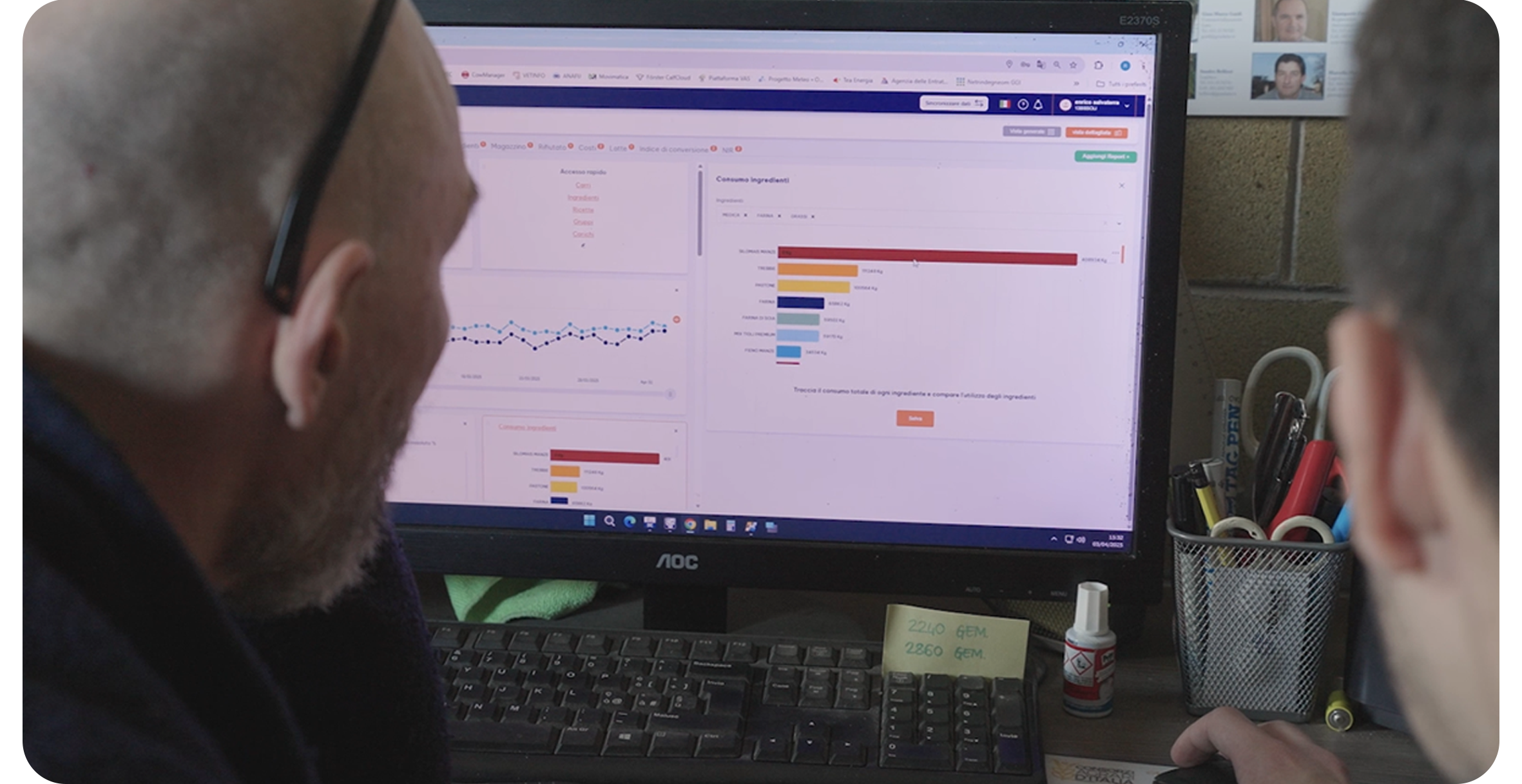
Over the last few years, dairy farms have made significant progress: more modern facilities, greater attention to animal welfare, and higher product quality.
However, the real management breakthrough does not depend only on infrastructure, but on the proper use of data.
Without accurate, consistent, and readable data, even the best decisions risk being based on perceptions rather than facts. In the video from which this article is derived, Cristian Rota addresses this topic, highlighting how data has become an essential tool for effective dairy farm management.
The lack of accurate data is one of the most critical—and underestimated—issues in farm management. When data is inaccurate, inconsistent and difficult to compare over time the farm loses the ability to understand what is really happening.
Without clear and well-defined information:
In practical terms, without reliable data, the farm loses its compass. And if you don’t know where you are going, you cannot know whether your decisions are correct.
Analyzing data does not mean collecting large amounts of information, but collecting it properly. Effective data analysis must:
Only in this way does data become a useful tool to understand what is working or not and where intervention is needed. Without clarity, even the most advanced technology loses its value.
Data represents the objective component of a sector that is often highly subjective.
Data belongs to everyone involved the farm, the nutritionist and the consultants. This objectivity makes it possible to create constructive discussions, speak the same language and align goals and strategies Data helps bring farms and professionals onto the same page, reducing personal interpretations and improving the effectiveness of decisions.
Data is also a powerful learning resource. A farm can grow only if it sets clear goals, invests in skill development and uses data to measure results. Data allows farms to:
In this sense, data is not only a control tool, but a driver of continuous improvement.
Data connects everyone involved in managing the feeding process.
It represents the informational asset of the farm.
When data is accurate, shared and used professionally it becomes a powerful tool to improve efficiency, communication, production and economic results.
Technology alone is not enough. Real value emerges when data is collected correctly, analyzed methodically, and used consciously.
Without clear data, it is impossible to understand what is happening. And without understanding what is happening, improvement is not possible.
Watch the full video, click here!


 NIR & Imaging
 Data Management
 Mobile Apps
 Load Cells
 Indicators and ISOBUS-ECU
 Accessories
 English
 Italian
 Spanish
 French
 German
 Portuguese (Brazil)
 Dutch
Dutch Polish
 Chinese (Simplified)
 Turkish
