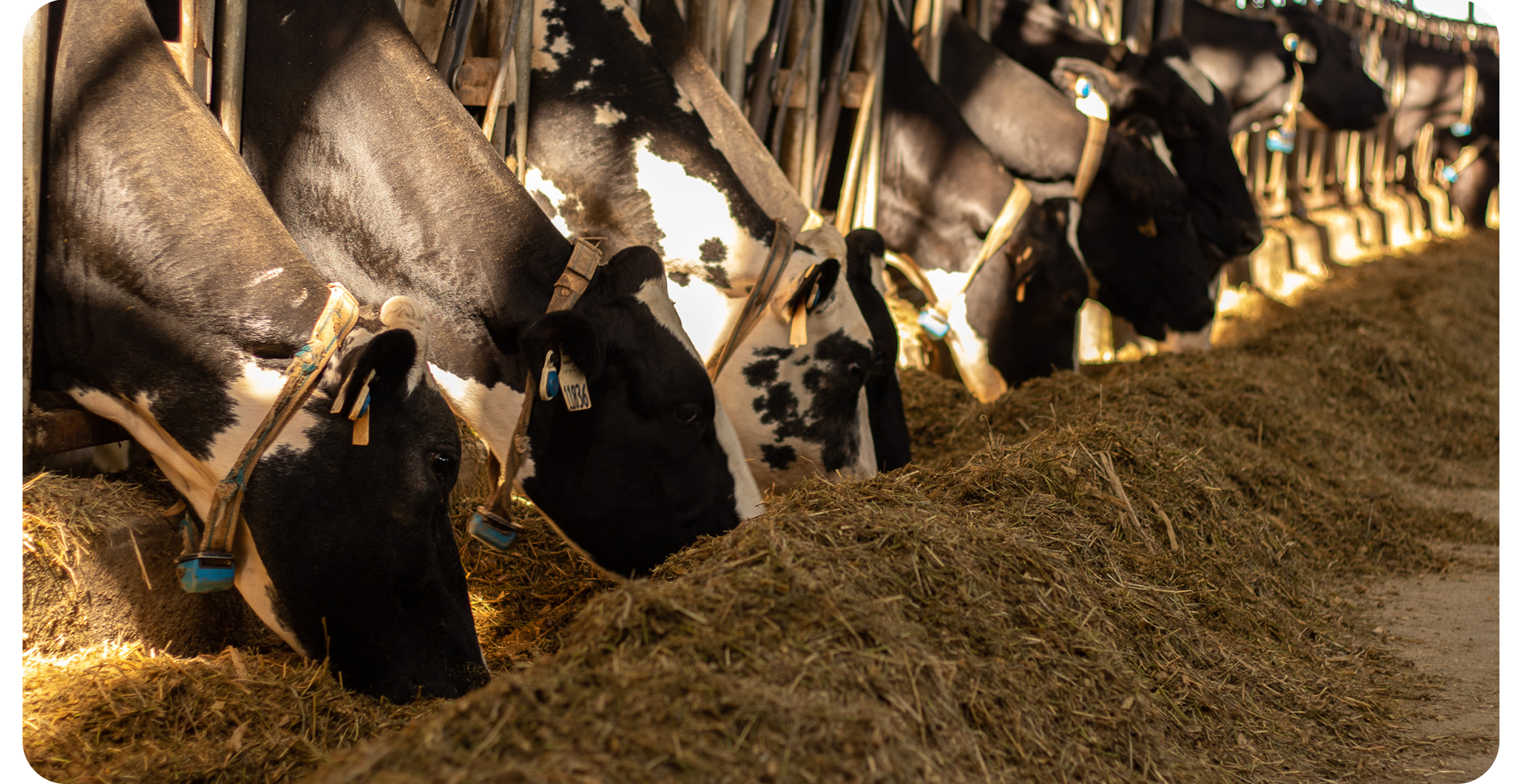
Recent research presented at the joint meeting of the American Dairy Science Association and the American Society of Animal Sciences confirms once again that dairy nutrition is far more than simply balancing ingredients on paper. Long-term studies conducted across hundreds of dairy herds continue to demonstrate how feeding strategies directly impact milk production, rumen efficiency, fertility, and overall farm profitability.
Modern dairy farms are increasingly relying on data-driven nutrition management to optimize performance while controlling feeding costs, which often represent up to 60% of total farm expenses.
One of the most important studies presented was a meta-analysis of 56 peer-reviewed trials evaluating the impact of dietary starch levels on dairy cows.
The research compared low-starch and high-starch rations and showed that reducing starch levels can negatively affect:
For every 1% reduction in starch:
Researchers highlighted that while lowering starch may reduce feed costs during periods of high grain prices, maintaining the correct balance of rumen fermentable carbohydrates remains essential to avoid performance losses and rumen instability.
At the same time, excessive starch levels can increase the risk of rumen acidosis, confirming the importance of continuous ration monitoring and adjustment.
Another key research topic focused on DCAD (Dietary Cation-Anion Difference), a nutritional strategy commonly managed through buffers such as sodium bicarbonate and potassium carbonate.
The analysis of 44 scientific studies demonstrated that increasing DCAD levels can significantly improve:
The study reported:
These benefits become particularly important during periods of heat stress, where maintaining rumen stability and feed intake is critical for dairy farm profitability.
Nutrition does not only affect production performance, it also plays a direct role in reproductive efficiency.
Research conducted on 49 commercial dairy herds in Wisconsin showed that excessive energy density, starch, and NFC (non-fiber carbohydrates) were negatively associated with conception rates.
Conversely, higher NDF levels were positively associated with fertility performance.
The research reinforces a critical concept in precision feeding:
Maximizing milk production alone is not always the best long-term strategy if fertility and herd health are compromised.
Balancing fiber sources, maintaining rumen health, and avoiding excessive dietary energy can help improve both reproductive efficiency and overall herd sustainability.
Another interesting study evaluated how different water sources influence rumen fermentation.
Results showed that water quality can directly affect:
Since water consumption is closely linked to feed intake and milk production, water quality should be considered an integral part of dairy nutrition management rather than a secondary factor.
The overall message emerging from these studies is clear:
Dairy nutrition is increasingly complex and dynamic. Feed composition, starch variability, water quality, rumen efficiency, and ration consistency all interact together to influence farm performance.
This is where precision feeding technologies become essential.
Modern dairy farms are moving toward data-driven feeding management solutions capable of monitoring:
Real-time NIR technologies and precision feeding software now allow nutritionists and farmers to continuously monitor feed quality directly on the farm, helping reduce variability and improve ration consistency every day.
Research continues to confirm that small nutritional variations can generate measurable economic impacts across large dairy operations.
Today, the challenge is no longer simply formulating a ration, it is ensuring that the ration delivered to cows remains consistent, measurable, and optimized every single day.
Technologies such as real-time NIR analysis and precision feeding management systems are helping dairy farms transform nutritional data into actionable decisions, improving efficiency, animal performance, and long-term profitability.
Click here to read the article.




 NIR & Imaging
 Data Management
 Mobile Apps
 Load Cells
 Indicators and ECU
 Accessories
 English
 Italian
 Spanish
 French
 German
 Portuguese (Brazil)
 Dutch
Dutch Polish
 Chinese (Simplified)
 Turkish