
Feed is one of the largest operating costs on a dairy farm. For this reason, even relatively small improvements in feeding accuracy, feed efficiency and waste reduction can have a meaningful impact on farm profitability.
This is where precision feeding software can create value.
By connecting ration planning with daily feeding execution, a digital feed management system can help dairy farms identify deviations, reduce unnecessary feed losses and monitor the economic performance of the feeding process.
But what is the real ROI of precision feeding, and where does this return come from?
Precision feeding ROI measures the economic return generated by improving how feed is planned, prepared, delivered and monitored on a dairy farm.
The return can come from several areas, including:
The actual financial return varies from farm to farm. Herd size, feed prices, current feeding accuracy and existing levels of waste or inefficiency all influence the potential benefit.
For this reason, precision feeding ROI should be evaluated using the farm’s own operational and economic data.
Feeding inefficiencies are not always easy to identify.
Small deviations during loading, mixing or unloading can occur every day without appearing significant. However, when they are repeated across hundreds of feeding cycles and many animals, their economic impact can accumulate.
Typical sources of feeding inefficiency include:
Improving feed efficiency therefore does not simply mean feeding less.
The objective is to make sure the ration formulated by the nutritionist is prepared and delivered as consistently as possible, while controlling the relationship between feed input, milk production and feeding costs.
Precision feeding software connects feeding plans, weighing data and actual feeding execution.
Instead of relying only on manual records, farms can compare what was planned with what actually happened during loading and unloading.
A connected feeding system can help users:
This creates greater visibility over the feeding process.
Once deviations or inefficiencies are identified, farm managers and nutritionists can take corrective action based on actual data rather than assumptions.
The ROI of a precision feeding system usually comes from a combination of several operational improvements rather than from one single factor.

These figures should not be interpreted as guaranteed results for every dairy farm. The achievable return depends on the farm’s starting conditions, management practices, feeding accuracy and cost structure.
This distinction is important because the greatest economic opportunity often exists where feeding variability or avoidable losses are already present.
A simple ROI calculation compares the economic benefits generated by the system with its cost.
A basic formula is:
ROI (%) = (Annual Economic Benefit − Annual System Cost) / Annual System Cost × 100
To estimate the annual economic benefit, a dairy farm can evaluate areas such as:
The calculation becomes more meaningful when it uses real farm data instead of generic industry averages.
For example, the value of reducing daily feed losses by even a small amount can be calculated across the entire herd and over a full year.
Click here to calculate your ROI
To understand how precision feeding ROI can be estimated, consider the following example of a dairy farm with 120 lactating cows.


Based on these assumptions, the farm can evaluate how relatively small changes in feed use, ration accuracy or productive efficiency affect annual profitability.
For example, reducing avoidable feed losses by only a small amount per cow per day can become significant when multiplied by 120 cows and 365 days.
The same approach can be applied to:
This illustrates why the starting point matters.
A farm with high feeding variability may have more room for improvement than a dairy operation that already works with very high levels of accuracy.
To determine whether precision feeding is actually improving profitability, farms should monitor both feeding and economic KPIs.
Useful indicators include:
These indicators should be interpreted together.
For example, a reduction in feed intake is not necessarily positive if it is accompanied by a decrease in milk production.
The objective is to improve the relationship between feed input, feeding costs and productive output.
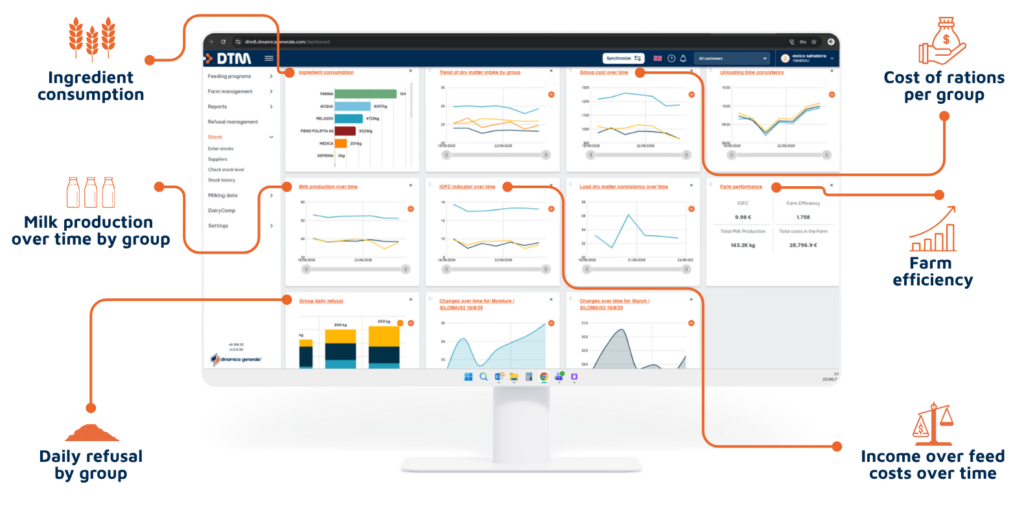
DTM – Daily TMR Manager is Dinamica Generale’s cloud-based feed management software for dairy farms.
The platform connects feeding plans with weighing data from the feed mixer, making it possible to compare planned feeding activities with actual execution.
DTM helps farmers, feeders and nutritionists:
By connecting weighing data with feeding management, the system provides greater visibility over the complete feeding process.
This makes it easier to identify where deviations occur and where operational improvements may generate economic value.
Financial return is important, but precision feeding can also provide operational benefits that are more difficult to express through a single ROI figure.
These may include:
Together, these improvements can help create a more controlled, measurable and repeatable feeding process.
Precision feeding ROI is the economic return generated by improving the planning, preparation, delivery and monitoring of feed on a dairy farm. Potential benefits can come from lower feed losses, greater feeding accuracy, improved inventory control and better feed efficiency.
Precision feeding software can help identify where feed is being wasted or where actual feeding differs from the planned ration. By improving visibility and control, farms can take action to reduce avoidable inefficiencies. Actual savings depend on the farm’s starting conditions.
The payback period varies between farms. Herd size, feed prices, current feeding errors, potential efficiency gains and the cost of the system all influence how quickly the investment can be recovered.
Not necessarily. Precision feeding primarily improves control and consistency in ration preparation and delivery. Milk production is influenced by many additional factors, including nutrition, herd health, genetics, environment and overall farm management.
Useful data includes herd size, ration cost, ingredient consumption, feed refusals, dry matter intake, milk production, feed price, loading deviations and feed efficiency.
Yes. The economic opportunity depends not only on herd size but also on the amount of feed handled, current feeding variability, feed prices and the improvements that can realistically be achieved.
Precision feeding is not simply about adding software to a feed mixer.
Its value comes from creating a measurable connection between the ration planned by the nutritionist, the ration prepared by the feeder and the results achieved by the farm.
By monitoring feeding accuracy, feed consumption, inventory and performance KPIs, dairy farms can identify inefficiencies and make more informed management decisions.
DTM by Dinamica Generale connects feeding management with weighing data to help farms monitor and improve the complete feeding process.
Discover how DTM can support a more connected, measurable and data-driven approach to dairy feeding.


 NIR & Imaging
 Data Management
 Mobile Apps
 Load Cells
 Indicators and ISOBUS-ECU
 Accessories
 English
 Italian
 Spanish
 French
 German
 Portuguese (Brazil)
 Dutch
 Polish
 Chinese (Simplified)
 Turkish

